
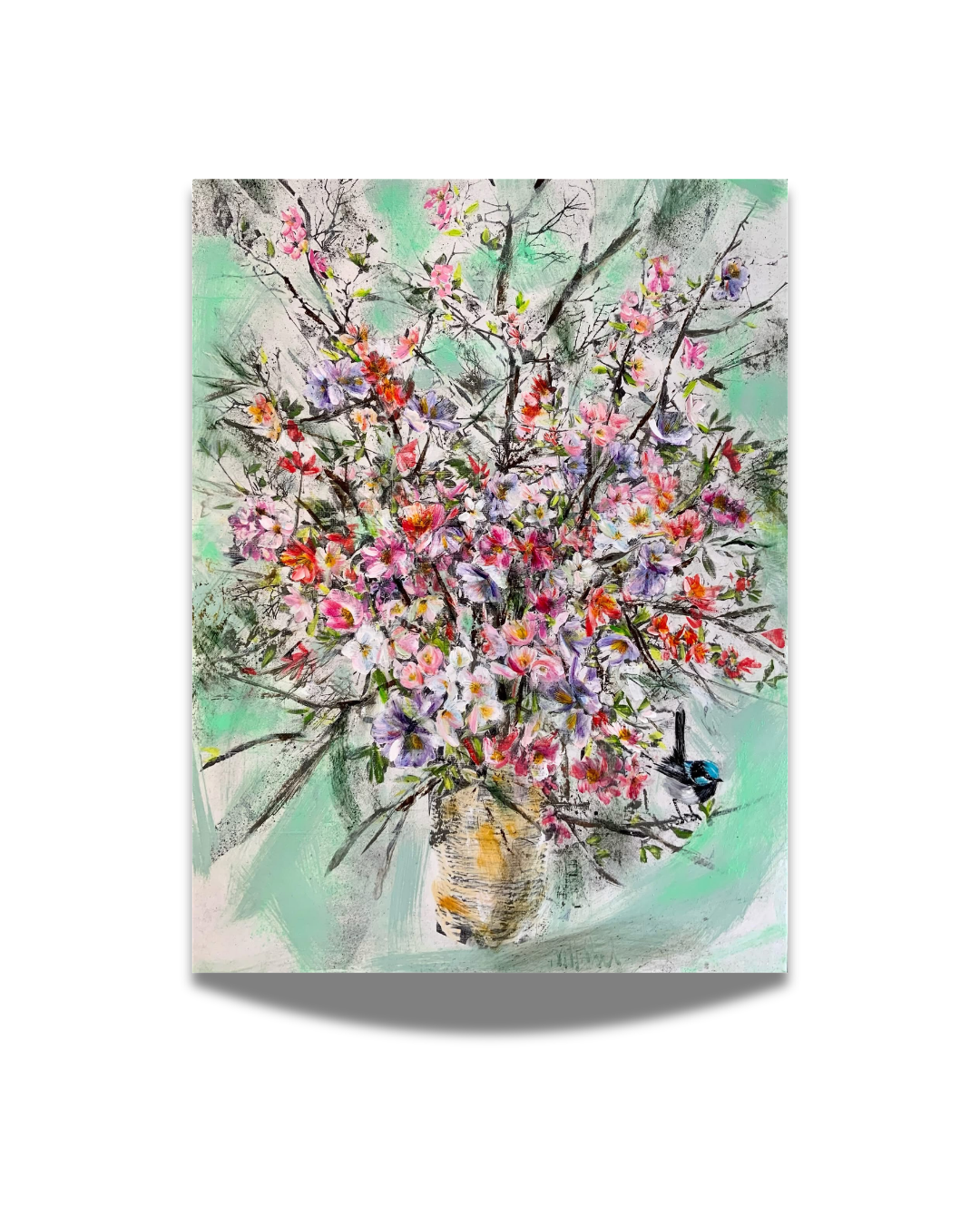
Mark Holland
Mark Holland is a contemporary representational artist whose paintings explore nature, memory, identity, and the human condition. Working across still life, botanical art, flora and fauna, and altered realities, he creates richly layered compositions that invite viewers to reconsider the visible world and the subconscious forces shaping their experience of it.
Born in the highlands of East Africa, Holland spent his formative years on the prairies of Illinois and among the farmlands of Indiana. His family moved frequently, giving him an early sense of being a child of the world but rarely of belonging to one particular place. Drawing and painting became a constant—a source of stability, discovery, and home.
Nature remains central to Holland’s artistic practice. It offers him peace, but also an inexhaustible field of inquiry. Through close observation and the act of painting, he seeks to understand his surroundings and his relationship to them. Flowers, animals, fantastical scenes, mythology, nostalgia, and memory recur throughout his work, while his interests in history, religion, science, and culture add deeper conceptual layers.
For Holland, representational art is a way of knowing. He believes that making sense of the self begins with making sense of what we see. His paintings engage both the waking world and the subconscious, offering a visual language through which he communicates with nature and examines our shared human experience.
In an increasingly fragmented, isolating, and technology-driven culture, Holland’s work encourages viewers to slow down, look closely, and reconnect with their physical and emotional environments. His paintings may be peaceful, restorative, cheerful, compelling, or, at times, unsettling. Art, for Holland, is never merely decorative; it is a form of testimony—a record of what people encounter both consciously and unconsciously throughout their lives.
Holland approaches each painting as an image-centered creation, often bringing together disparate or seemingly incongruous elements. Through juxtaposition, these unrelated images begin to form unexpected connections, creating enigmatic visual narratives and open-ended stories. His compositions can feel baroque and mysterious while remaining grounded in recognizable forms and shared experience. Some images carry hidden meanings; others are included simply for the beauty, strangeness, or emotional pull of the object itself.
The natural world is a continual visual feast for Holland, reflecting its treasures, mysteries, terrors, peace, and beauty back to the viewer. His paintings ask us to consider what we see, what we remember, and what may be quietly unfolding beneath the surface.
Holland’s body of work encompasses three primary genres:
Still life
Botanical art, flora, and fauna
Altered realities and the human condition
His work is held in private and public collections throughout the United States and internationally and has been represented by art galleries and auction houses across the country.
“We are united by our sense of place. Nature is our commonality.”
“Drawing is the essence of art.” — Jean-Auguste-Dominique Ingres